
Episode Synopsis:
Frieren and company help a merchant stuck at a mountain pass and escort him to the town beyond, which is celebrating the anniversary of Himmel and the adventuring party liberating the town from demonic forces, all those decades ago. After musing on the subjects of history and the passage of time, the trio strike northwards once more.
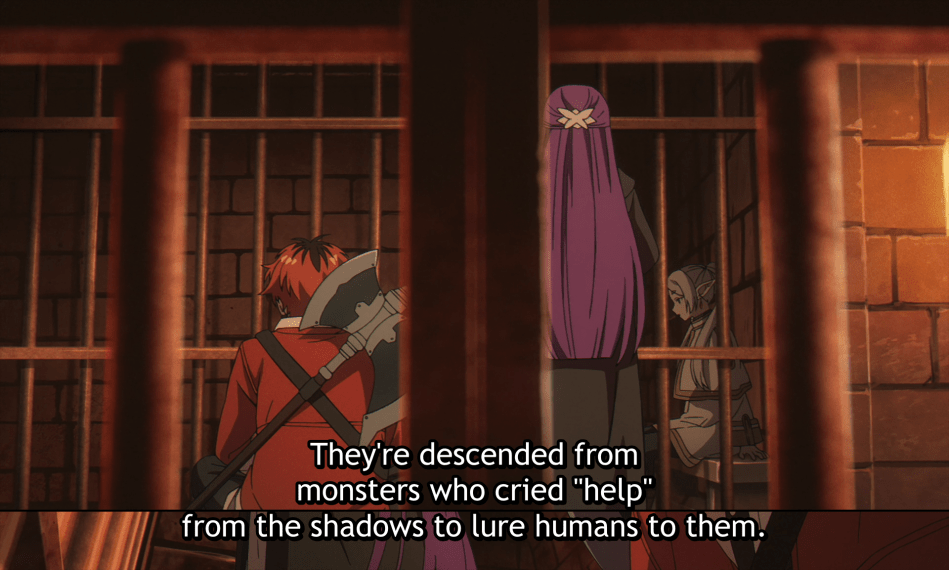
A subsequent town on their path is found to be harboring demons playing the part of diplomatic envoys. Frieren is imprisoned for reflexively brandishing her weapon, and tells her companions not to trust anything that comes out of a demon’s mouth while the audience is shown a flashback of an incident where Himmel gave a small demon the benefit of the doubt, to tragic consequence. Scenes from the demons’ perspective in the present seem to confirm that they are possessed of a certain animal cunning and are successfully manipulating the local government, but how they’ll be able to deal with the visiting elf is another question…
Episode Review:
The main thing going on in this episode is the question of how demons work. Frieren exposits in the flashback that “demons don’t raise their young” – I feel like the phrasing here implies that demons do reproduce, somehow (eggs?), but I guess it’s still possible that they’re spontaneously generated from dark energy or something. She goes on to say that they’re “solitary creatures by nature” (later in this same episode, one of them imagines an army of hundreds upon hundreds of organized demons preparing to sack the city, but go off [EDIT: apparently those are just puppets – in fact, the three demons introduced in this episode are the only ones we ever see working with Aura] ), which leads into the main question of how they actually learn Japanese (or whatever language they’re speaking) in the first place. The most telling scene on this subject is one near the end, after the main “diplomat” demon, Lügner, defuses a situation where he was accused of being responsible for killing the son of the local governor by countering with a story of how his own father lost his life fighting against humans – one of the two younger demons serving as his aides later asks, “What is a ‘father’?”, to which he replies “Who knows?”.
This is such a weird flex. If he thought he was still within earshot of the humans, this would be a pretty suspicious thing to let slip, so he’s either hamming it up for his subordinates (weird) or legitimately isn’t sure (even weirder). I actually believe that this is a jab at how the Japanese language distorts to accommodate certain kinds of formality – they use chichiue for “father” here, which is part of a formal speech set which I think is mainly used by nobility (you hear a lot of these in Escaflowne, if memory serves). I haven’t gone back to chart out other usage, but otou-san is likely to be the default among commoners – note that the demon in the flashback uses the maternal counterpart okaa-san while in a rural village. Since Lügner is ostensibly an upper-class official, he must know this well enough to use the word perfectly in context. Was he sure of this going in, in which case he’s just teasing his aide (subtly maintaining his position of dominance?), or was he advised to use an unfamiliar word by his own superior(s) and is just as surprised as she is that it worked without a hitch?
I just feel weird thinking about this because that exchange seems like it’s supposed to feed directly into taking Frieren’s dehumanization of them at face value. I mean, obviously they’re not human – Flamme herself is said to have codified the use of the word demon (mazoku?) to refer to monsters (mamono?) that can speak – but what, technically, is a monster in this world, anyway? Maybe they don’t have souls (by which I mean that I don’t know whether or not this is a thing), but would that be a useful distinction on the ground? Surely they’re not parrots, or chatbots – that one guy created his own horrifying magic spell. If they’re not sentient, are any of us? (please direct your attention away from neuroscience studies that suggest free will to be an illusion) Rather than claim that they don’t really know what they’re saying (only that whatever it is gets results), couldn’t we have simply focused on how evil they are? They certainly seem to be that, and I feel like that’s been enough in other settings.
Like, sure, allow that demons don’t have parents (practically if not literally), and then if they actually were solitary predators that attacked humans in the wilderness they might hear their victims cry out for their parents to the point where they’d try it themselves in the reverse circumstance. Most, uh, stages of human reproduction occur behind closed doors, so the specifics might genuinely be esoteric knowledge among demons in this scenario (and the encounter in the flashback seems to track with this, since, amongst other misconceptions, that demon seems to genuinely not understand that children aren’t really interchangeable), but these weirdos are dressed to the nines here. There is a for-real war going on, that has been going on for at least one human generation at this point (several if you count back to the original adventure), and they are engaging in delicate subterfuge in service to, if not a nation-state per se, some sort of internal hierarchy that leads back to the Sage Aura. It just seems so absurd to think that they could muster this level of diplomacy – even fake diplomacy – without studying our culture enough to register our habits of raising our offspring, even if not producing them.
I dunno.
ANYWAY – Looking forward to these chumps getting absolutely stomped when they finally break the charade.
Summary:
 The Con Artists
Pingback: Sousou no Frieren – Episode 06 – The Con Artists
Pingback: Sousou no Frieren – Episode 08 – The Con Artists